02 · Local care realities
Evidence interpreted for the settings where care happens.
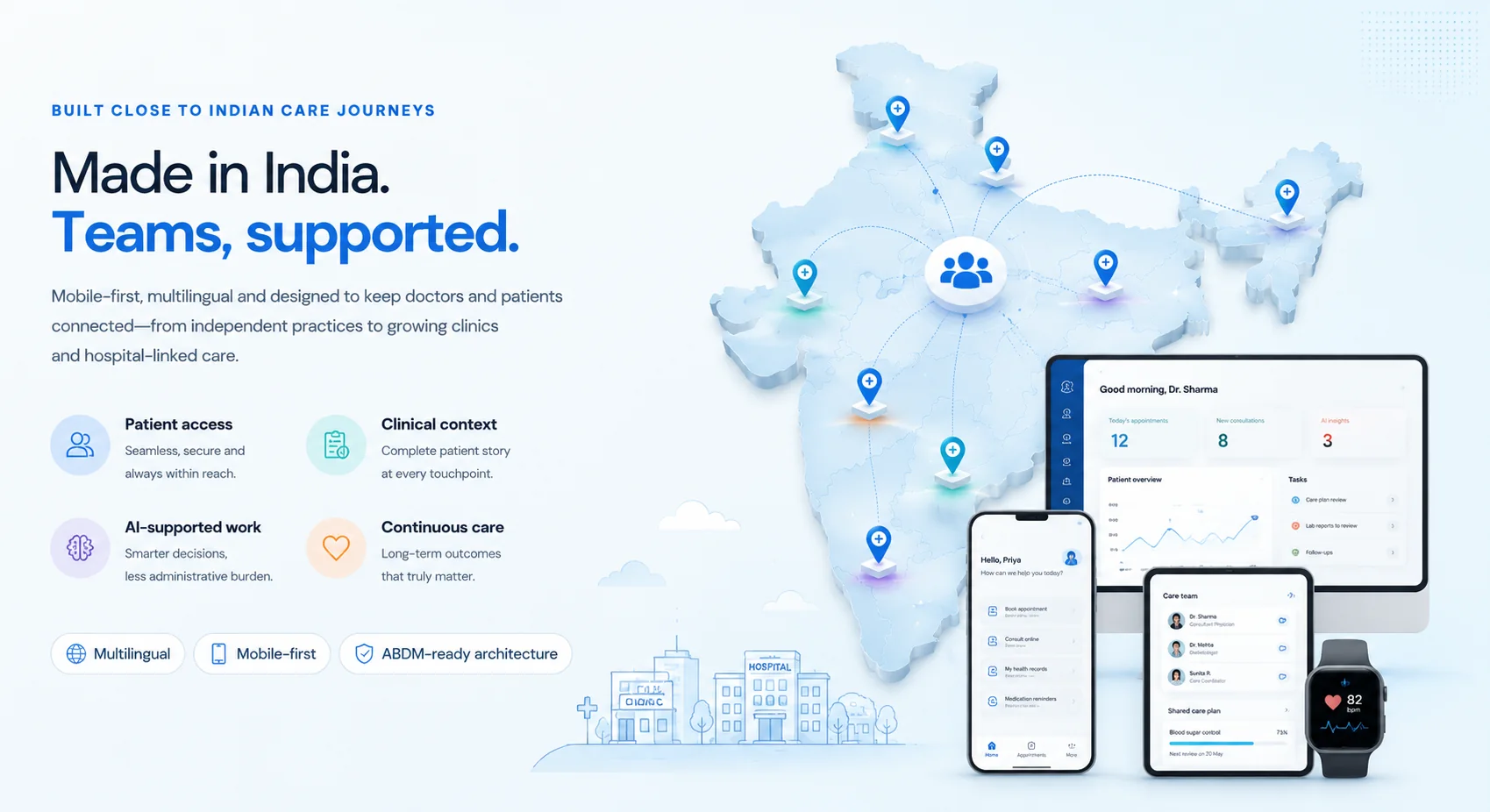
Mobile-first access, multilingual communication and varied infrastructure shape how connected-care evidence becomes useful in India.
 Preventive health
Peer-reviewed evidence and original perspectives on continuity, patient agency, remote monitoring and responsible clinical AI.
Ten literature-led briefings supporting NivaCare’s mission to connect doctors and patients, strengthen prevention and keep clinicians in control.
Mobile-first access, multilingual communication and varied infrastructure shape how connected-care evidence becomes useful in India.
Ideas stay connected to the problems patients and clinicians actually experience.
Prevention works best when insight, action and follow-up remain connected.
A systematic review of primary-care populations found that stronger personal continuity with a GP was associated with better healthcare outcomes. It supports NivaCare’s core premise: technology should preserve the doctor–patient relationship and carry its context forward.
Peer-reviewed studies and systematic reviews, translated into a concise explanation of what each finding means for connected, preventive care.
2025 · Systematic review · British Journal of General Practice
A systematic review found that stronger personal GP continuity was associated with benefits across mortality and healthcare use. NivaCare should help the relationship retain memory across visits, locations and channels.
Read the GP continuity systematic review (opens in a new tab)
2026 · Systematic review & meta-analysis · JMIR
This review of 55 randomised trials examined apps, telemonitoring and connected devices using validated self-care outcomes. Evidence was heterogeneous and mostly low or very low certainty, with clearer benefit for selected monitoring outcomes than for self-care overall. NivaCare should therefore connect daily action and clinical review while measuring outcomes by condition.
Read the chronic-disease self-care review (opens in a new tab)
2026 · Systematic review & meta-analysis
Mobile and web interventions showed favourable signals for patient knowledge and selected behaviours, while evidence for empowerment and clinical outcomes remained mixed. Clear explanations should therefore be paired with measurable outcomes.
Read the digital patient-communication review (opens in a new tab)
2025 · Systematic review & meta-analysis · Frontiers in Public Health
Across 31 studies and 9,559 adults, telemedicine combining home monitoring with provider support improved blood pressure and self-management outcomes. The finding supports RPM as a relationship-enabled workflow rather than a stream of isolated readings.
Read the home blood-pressure telemedicine review (opens in a new tab)
2024 · Meta-review · Journal of Medical Internet Research
A meta-review evaluated physical-activity and diet apps targeting major cardiovascular risk factors including blood pressure, glycaemic measures, body composition, blood lipids and activity. It supports bringing risk, activity and follow-up together in one understandable preventive-health view.
Read the cardiovascular-risk app meta-review (opens in a new tab)
2024 · Systematic review · PLOS Digital Health
A review of 106 studies found extensive use of mHealth, telemedicine and tele-education, alongside practical barriers for healthcare providers. Tier 1, 2 and 3 access needs technology that adapts to local workflows and constraints.
Read the India telehealth adoption review (opens in a new tab)
2025 · Systematic app review · NIMHANS and IIIT Bangalore
A systematic review of apps available to Indian users examined professional involvement, empirical basis, information quality and prompts to seek help. It supports screening that informs a clinician and escalates responsibly rather than acting as a standalone diagnosis.
Read the review of mental-health apps in India (opens in a new tab)
2026 · Qualitative content analysis · JAMIA
Analysis of 200 encounters found clinicians commonly edited factual details, symptoms, medicines, orders and diagnostic certainty. The evidence supports NivaCare’s human-approval model: AI prepares; the clinician verifies and decides.
Read the study of clinician edits to AI notes (opens in a new tab)
2023 · Qualitative study · Kerala, India
Patients, carers and clinicians described difficulty carrying and locating relevant diabetes and hypertension information across visits. A connected longitudinal record should support handover, self-management and safer decisions—not reproduce paper fragmentation digitally.
Read the Kerala patient-held-records study (opens in a new tab)
2022 · Systematic review · JMIR
A review of digital records for people with chronic conditions found frequent benefits for recommended-care use, disease knowledge, engagement, adherence and self-management. Records create value when they help patients understand and act.
Read the patient-centred records review (opens in a new tab)
Evidence note: These summaries interpret peer-reviewed literature in relation to the NivaCare mission. They do not claim that any study evaluated NivaCare itself. Study populations, methods, limitations and applicability should be reviewed in the linked publication.
Original thinking for doctors, patients and healthcare leaders building more continuous care.
29 July 2026 · 6 min read
A practical model for connecting preparation, the consultation, follow-up and monitoring without forcing patients or clinicians to reconstruct the story.
29 July 2026 · 7 min read
Five questions every clinical AI workflow should answer about intended use, human review, evidence, consent and escalation.
29 July 2026 · 6 min read
Why interoperability becomes meaningful only when patient control, consent and the next clinical action remain visible.
Peer-reviewed evidence summaries and clearly identified NivaCare perspectives on connected, preventive care.
No. Evidence summaries interpret published research and link readers to the original sources and limitations.
Each asks how technology can preserve continuity, patient agency and qualified clinical responsibility.

Tell us where the patient journey fragments today. It may shape a future NivaCare perspective.