Preventive health
How connected care reduces gaps between visits
The real unit of care is the journey—not the isolated appointment. Four transitions deserve deliberate design.
Fragmentation is rarely one dramatic failure. It is the accumulation of small breaks: a report not seen, an instruction forgotten, a symptom shared too late, or a follow-up that never happens.
The real unit of care is the journey
A consultation may last minutes, but the patient's work begins before it and continues long after. They book, gather reports, recall symptoms, follow instructions, monitor changes and decide when to seek help again. When each action lives in a separate channel, context is lost and both patients and clinicians repeat work.
Connected care treats those moments as one longitudinal workflow. It does not require every system to be replaced. It requires the patient identity, relevant clinical context, responsibility and next action to travel together.
Four transitions deserve attention
1. Before the visit
Patient-entered symptoms, reports, medicines and requested screening can be organised before the appointment. The clinician starts with useful context; the patient arrives better prepared.
2. During the consultation
Clinical documentation should preserve the conversation without competing for attention. Drafts can support the clinician, but approval and judgement remain human.
3. Immediately after
Prescriptions, instructions, tests and follow-up should become a clear shared plan—not separate messages the patient must interpret alone.
4. Between visits
Symptoms, vital signs, adherence and questions should re-enter the same care journey. Clear thresholds determine what can wait, what needs review and what requires urgent escalation.
What to measure
A connected-care pilot should begin with a narrow care gap and observable measures. Examples include completed pre-visit information, time spent reconstructing history, documentation turnaround, follow-up completion and clinically appropriate escalation. Measures should be agreed before deployment and reported without overstating causality.
India needs continuity that travels
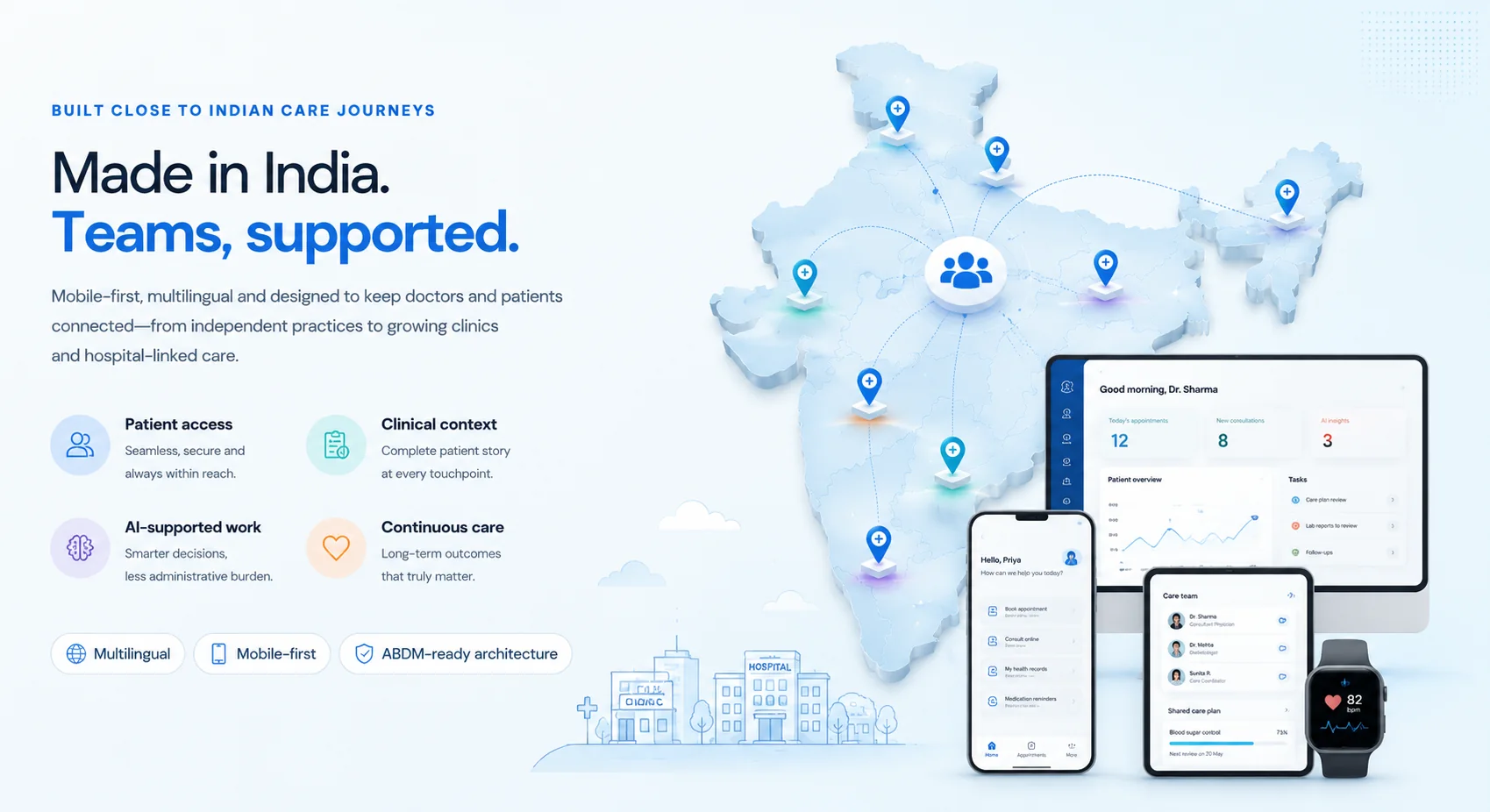
Patients may move between neighbourhood clinics, laboratories, specialists, telehealth and family-supported care. Mobile-first, multilingual and standards-oriented design can help continuity travel across Tier 1, Tier 2 and Tier 3 locations—while consent, access and local workflow remain central.